
Breaking sports news video. MLB, NFL, NBA, NHL highlights and more.
Showing posts with label Tour de France. Show all posts
Showing posts with label Tour de France. Show all posts
Monday, July 04, 2011


Monday, October 18, 2010
Alessandro Petacchi
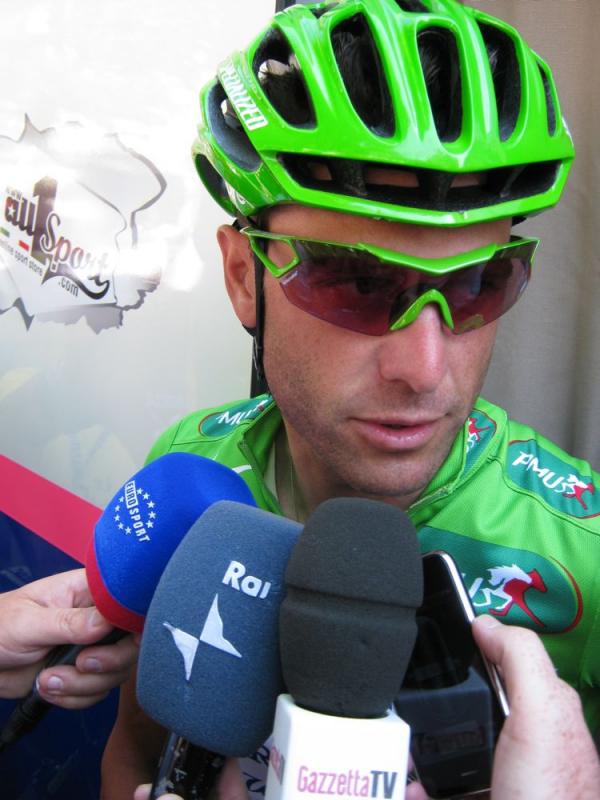 Ale-Jet won't be attending the 2011 Tour de France route presentation. OK. That's understandable given the witch-hunt-like environment that's enveloped professional cycling and is making it impossible for riders even casually suggested to potentially be possibly connected to a situation tangentially related to doping to move about publicly without being subjected to sometimes-humiliating treatment at the hands of the "authorities" AND the fans. It's a shame, nevertheless, and is a discouraging example of how stakeholders in cycling have become experts at cutting off their noses to spite their own faces.
The idea that there can't be a middle ground between the kind of unquestioning support and blind loyalty demanded by an accused-doper like Lance Armstrong, and the savage abuse that is still heaped upon a convicted-doper like Riccardo Ricco is downright silly. When did professional cycling become an environment in which it was believed that corruption could not - would not - exist in a similar proportion to that which is found in business, politics, or even other sports? How is it that seemingly otherwise-rational, university-educated, wealthy, sophisticated fans lose all perspective when it comes to doping in cycling and take such great personal offense when it's revealed that the athlete who they idolized, lionized, dreamt about and even imitated (by shelling-out $200USD for a pair of team-issue bibs, jersey, gloves, socks and cotton cap) is doping in an effort to ride faster, often in the hope of making more money?

Friday, October 08, 2010
Clenbuterol and the Tour de France

I still don't believe that Contador doped with clenbuterol during the Tour de France, and I hope that he can answer the five questions we previously identified here, and explain satisfactorily how the drug entered his body. Unfortunately, that seems less-likely now with this allegation coming from an unnamed source close to the Astana team, as reported by VeloNation:
"Belgian magazine Humo has published claims from an individual with the Astana team, who alleges that Alberto Contador used Clenbuterol after the Criterium du Dauphiné as part of a weight-loss treatment. The person, who spoke on condition of anonymity, claims that the Spaniard had blood extracted between that race and the Tour when, crucially, traces of the banned product were still in his system.
“He had a transfusion performance after the Dauphiné Libéré [Criterium du Dauphiné], and the blood still contained a little bit of clenbuterol from a just-finished slimming treatment,” Humo reported the insider as saying.
“In the Dauphiné Libéré, Contador was still a little overweight. Ordinary people do not see that, but there was still a pound or two to shed. Clenbuterol is used to get rid of the last kilos while, at the same time, to ensure that you do not lose muscle mass - or, in the best case, even gain a little extra muscle mass.”
He described how the technique works, saying that the substance is used in combination with another
“You have to use it in combination with T3 [Triiodothyronine]. This is a thyroid hormone that helps in the digestion of fats. Then you have more rapid effect with a smaller dose of Clen. And the smaller the dose, the smaller the chance that you get caught.”
Contador finished second overall in the Dauphiné, but appeared to be below his usual strength there. He was beaten by an impressive Janez Brajkovic (Team RadioShack), who finished 1’41 ahead at the end of the event. Contador was only sixth behind Brajkovic in the time trial and was unable to drop his rival on the crucial stage to Alpe d’Huez, although he won the sprint to the line..."
And as an aside, in the same report the anonymous source claimed that doping via transfusions continues as before, much like Bernhard Kohl alleged, when he said it was not possible to win the Tour de France if doping was still endemic. VeloNation continues:
"The biological passport is being used as a deterrent to prevent riders from doping. While it has made it more difficult to beat the system, the Astana source told the magazine that some riders continue to manipulate things at a lesser level.
“Of course,” he said, when asked if transfusions continue. “But it’s in small doses of 150cc. Previously, riders during the Tour used two, three big bags of blood, from 400 to 500 cc. Now they cannot afford to, because of the biological passport and the sudden fluctuations in blood levels that occur.”
Sigh. I love this sport, I really do, and I'm sorry for my role in perpetuating the doping problem, but darn, if it's proven that Contador doped (and by proven, I mean there's a CAS ruling that closes the door on any appeals), then maybe that will be the nail in the coffin that will get me out of this trance and help me see the world through lenses other than a cyclist's Oakleys.
Tuesday, October 05, 2010
Bernhard Kohl is Not the Enemy of Cyclesport

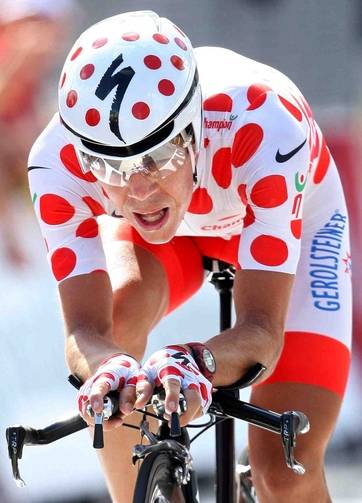
And just to clarify, it was Roy Sentjens who said that you couldn't finish in the top-10 without doping, not Bernhard Kohl.
Monday, August 02, 2010
Barredo vs. Costa
As I mentioned previously in response to The Fixed Factor's excellent blog post, "A Fine Bromance," homoerotic face-patting has no place in the Tour de France, let alone between the Yellow and White Jerseys. I'm an AC fan (tho much less so after he flicked VINO), but the love-in with Schleck should have earned them both a fine! And in retrospect, Renshaw vs. Dean and Barredo vs. Costa (see below) should have earned those riders BONUSES for the displays of fighting spirit.
A Fine Bromance: Schleck and Contador on the Col du Tourmalet

In Master Jacques, Richard Yates argues that it was spite that ensured Anquetil would never win the world title. His rivalry with Raymond Poulidor was so intense that he spent more time preventing Poulidor from winning the world title than trying to win it himself. In other words, it was more important to Anquetil to stop his rival from being world champion than to be world champion himself.


Read more of "A Fine Bromance: Schleck and Contador on the Col du Tourmalet," at The Fixed Factor, here.

Wednesday, July 21, 2010
Recommended Reading
Our apologies for not posting this sooner, but at least you'll be able to root through the archives after the Tour concludes, and relive your favorite moments. One of the best daily blogs to follow and analyze the race is Blazin' Saddles, which appears via Yahoo! Eurosport. Pappillon strongly recommends it. Excerpt:
"Stage 17 prediction: After the rest day both Contador and Schleck are going to be caught napping as they continue their discussion on the pros and cons of Tour protocols. Menchov will show the world just why he's called 'The Silent Assassin' by knifing them both in the back before powering up the Tourmalet. Despite falling twice on the ascent, the Russian will ghost into the yellow jersey, with Sanchez moving into second. Fabian Cancellara will complain via a video on YouTube. Andy will get very angry once again, but then forget all about it and hug Alberto."

In Saddles' own words:
"Ever since he was bullied by his brothers into watching the Tour de France as an eight-year-old, Blazin' Saddles has been a cycling fanatic. As persistent as Voigt, as fast as Abdoujaparov, as voracious as Ullrich and as accurate as a Festina watch, Blazin' Saddles offers a lighter take on the oft-grave world of professional cycling. The self-styled best cycling-blog pedlar in the business, BS refutes sullied claims of doping levelled by his rivals: these nuggets are powered on Gerolsteiner fizzy water alone. Just ask BS's friend Bernhard Kohl for a reference."
"Stage 17 prediction: After the rest day both Contador and Schleck are going to be caught napping as they continue their discussion on the pros and cons of Tour protocols. Menchov will show the world just why he's called 'The Silent Assassin' by knifing them both in the back before powering up the Tourmalet. Despite falling twice on the ascent, the Russian will ghost into the yellow jersey, with Sanchez moving into second. Fabian Cancellara will complain via a video on YouTube. Andy will get very angry once again, but then forget all about it and hug Alberto."

In Saddles' own words:
"Ever since he was bullied by his brothers into watching the Tour de France as an eight-year-old, Blazin' Saddles has been a cycling fanatic. As persistent as Voigt, as fast as Abdoujaparov, as voracious as Ullrich and as accurate as a Festina watch, Blazin' Saddles offers a lighter take on the oft-grave world of professional cycling. The self-styled best cycling-blog pedlar in the business, BS refutes sullied claims of doping levelled by his rivals: these nuggets are powered on Gerolsteiner fizzy water alone. Just ask BS's friend Bernhard Kohl for a reference."
Tuesday, July 20, 2010
UPDATED: Spare a Thought for Nicolas Roche
Pappillon knows better than most what it is like to deal in the shady world of back-stabbing evil opportunists and scoundrels - and the French. We've even been accused to be better suited for life in that hopeless and evil realm than pleasant, civilized society (though were that the case, we would attribute such a mutation to the death of Pappillon Sr. and the abandonment of his off-spring - or at least one of them - to wolves by Mrs. Pappillon Sr.). Nevertheless, running with the big dogs means peeing in the tall grass, just as playing with fire will sometimes see you burn. But all's well that end's well, even if Life's a Bitch.

Speaking of which...as we sit here brooding about the injustices we've wrought upon ourselves with spectacularly-poor decision making skills regarding our aspirations for success in the import/export field, we sometimes try to convince ourselves that, while life is a b#tch, it's often difficult to forever escape karmic retribution, even if you've won more Tours de France than anyone else. Everyone eventually gets what's coming to them - hopefully.
Nevertheless, the mantra that "what goes around, comes around" is a limp and frigidly ineffective comfort when considering the case of former Irish national champion Nicolas Roche of the Ag2r-La Mondiale cycling team. It's the great travesty of the 19th and 20th of July that most of the English-speaking cycling world cries crocodile tears on behalf of a Christ-like Andy "Preying Mantis-head" Schleck, while nary a thought is spared for the one rider who was truly, positively wronged during yesterday's fifteenth stage of the Tour de France.

Recent converts to the anti-Alberto brigade complain furiously about the Spaniard's supposed violation of cycling's "unwritten" rules, but it was Roche who was egregiously and violently shafted by his French teammate John Gadret (unfortunately a favorite of friend-of-Pappillon, Bobke Strut) in a glaring display of rule-breaking. If it's not codified in Ag2r's contracts as a written clause, it should be, but everyone knows that if you're being paid to ride on behalf of a team leader, one of your principal responsibilities is not only to wait for him should he suffer a mechanical incident, but to give him your wheel or even bike if the situation requires it and he can't continue on his own machine.
Everyone heaping scorn on Alberto Contador for trying to win the Tour de France should instead refocus it on John Gadret, especially if you're Irish!
Why target Gadret for the most epic, grassroots-catalyzed ball-breaking in the history of Internet-followed Tour de France racers and fanboys galore? I'll let Nicolas explain in his own words:
"...Six kilometres from the top of the climb [the Port de Bales], just as the pace began to increase at the front, I punctured a front wheel. I pulled over to the side of the road and as [John] Gadret was riding behind me, I asked him for his wheel as he rode alongside.
This is a perfectly normal request if the team car is not around. To save time, a team-mate will often give his team leader a wheel or even his bike if necessary. I have done it plenty of times over the years, as have most cyclists, amateur or professional, at some stage in their careers.
As our team car was No 11 in the cavalcade and it would take a lot of time for them to get to me through the streams of dropped riders, I asked Gadret -- who was there to help me -- for his wheel. I couldn't believe what happened next. He just shook his head and said 'Non'. At first I thought he was joking, but soon realised he wasn't when he kept riding past me..."
As my team manager, Vincent Lavenu, in the car behind shouted into Gadret's earpiece to wait, I took my wheel out and waited for a new one. All the time the group -- including Gadret -- was riding up the mountain, away from me..."
Is it any wonder then that Roche started his latest column for the Irish Independent with the following lead? "If John Gadret is found dead in his hotel room in the morning, I will probably be the primary suspect."

Why choose sides in a baseless and completely overblown fake-drama concerning a botched shift, when you can choose sides in a serious and legitimate scandal concerning a front wheel puncture and shameless disloyalty and selfishness! You can join the FaceBook group "Don't Ride Like John Gadret - a Shameless and Disloyal Opportunist" to share your displeasure at John Gadret with like-minded individuals.
Quote of the day: "Very angry!!! Puncture happens but being left behind by attacking team mate is other!" An annoyed Nicolas Roche took exception to AG2R team-mate John Gadret's ill-timed attack - just as Roche had punctured at the foot of the Port de Bales. The Irish-Frenchman removed this tweet shortly after putting it up online. - H/T Blazin'Saddles
UPDATE: Expert Analysis - Pappillon asked the victim's father, Stephen Roche (himself a Tour winner - from the "Golden Age" of modern pro cycling, no less), for his thoughts on the stage. We're happy to share them here:

"The highlight of the day would have been the attack of Contador, which in actual fact was the attack of Schleck. People are putting too much emphasis of the fact that Contador attacked Schleck, when in actual fact Schleck attacked first and Contador basically came after him and went by him. I think it was very unfair to say that Contador attacked Schleck, when in actual fact it was the other way round.
The fact that Schleck had mechanical trouble – that's his problem. It's all just part of the race. You can't just stop the race if some guy makes a mess of his gears, or his gear change or chooses the wrong gear or has a mechanical problem, that's just the way it goes. Contador was actually hesitant to go on, he looked around a couple of times before he actually put his head down, and he was with Menchov and Sanchez so what was he expected to do? Should he have backed off and said “I'm sorry, my good friend down the road there has had a problem and I'm going to wait for him”?
Schleck was blessed with the stage into Spa where Cancellara actually cancelled the race so Schleck could get back on again. At the end of the day, it's all part of bike racing. If the guy had been on the ground, and had a fall, or an injury or whatever, you'd say yeah okay, it's not the in thing to attack – but the race was in full flight and Andy Schleck launched the race himself.
I didn't hear his comments at the finish, but for me I have no problem at all with the way Contador rode and I think we should look at the thing from the mechanical cycling point of view rather than that of a journalist who just sees the guy attacking, he doesn't see the actual mechanics of the thing. People believe what journalists say, like Contador shouldn't have attacked – but that's just coming off the top of the journalist's head, whereas if he analysed what happened he would have to change his view because Schleck attacks, first of all, then Contador comes after him and goes past him – as he's going past him, Schleck has a problem.
Contador was in full flight, so he can't stop. Well, he could have stopped, but they're in the middle of a war and you don't stop the battle because a guy's chain has come off. They're professional bike riders, it's not a game they're playing – these boys are getting paid for what they're doing in a professional sport and we all love to see the attacking and the spectacle.
Andy Schleck rode a brilliant race to get back and only lose 30 seconds because he came back to earn 12 seconds on top of the climb. It was a great ride by Andy Schleck, and that's what makes champions. Contador could have said “Andy, I'll wait for you because I'm going to take the Yellow Jersey off you anyway, in Bordeaux” and then we would all have said Contador is no tactician, he has no panache, he's just relying on the final time trial. I think what happened today was great racing and don't focus on the fact that Schleck had a chain problem as it's all part of bike racing."
Final Thoughts: Thanks to Nicolas Roche himself for the follow on Twitter - we promise to restrain our tweeting so as not to flood your inbox. Click here to follow Roche yourself, and to show your support for Irish cycling (and Team ag2r-LaMondiale). And of course, you can follow Pappillon on Twitter, where we post links to shocking direct evidence of doping every time another 50 followers are added.

photo Copyright © 2010 Reuters/steephill.tv
Speaking of which...as we sit here brooding about the injustices we've wrought upon ourselves with spectacularly-poor decision making skills regarding our aspirations for success in the import/export field, we sometimes try to convince ourselves that, while life is a b#tch, it's often difficult to forever escape karmic retribution, even if you've won more Tours de France than anyone else. Everyone eventually gets what's coming to them - hopefully.
Nevertheless, the mantra that "what goes around, comes around" is a limp and frigidly ineffective comfort when considering the case of former Irish national champion Nicolas Roche of the Ag2r-La Mondiale cycling team. It's the great travesty of the 19th and 20th of July that most of the English-speaking cycling world cries crocodile tears on behalf of a Christ-like Andy "Preying Mantis-head" Schleck, while nary a thought is spared for the one rider who was truly, positively wronged during yesterday's fifteenth stage of the Tour de France.

photo Copyright © 2010 Fotoreporter Sirotti/cyclingfans.com
Recent converts to the anti-Alberto brigade complain furiously about the Spaniard's supposed violation of cycling's "unwritten" rules, but it was Roche who was egregiously and violently shafted by his French teammate John Gadret (unfortunately a favorite of friend-of-Pappillon, Bobke Strut) in a glaring display of rule-breaking. If it's not codified in Ag2r's contracts as a written clause, it should be, but everyone knows that if you're being paid to ride on behalf of a team leader, one of your principal responsibilities is not only to wait for him should he suffer a mechanical incident, but to give him your wheel or even bike if the situation requires it and he can't continue on his own machine.
Everyone heaping scorn on Alberto Contador for trying to win the Tour de France should instead refocus it on John Gadret, especially if you're Irish!
Why target Gadret for the most epic, grassroots-catalyzed ball-breaking in the history of Internet-followed Tour de France racers and fanboys galore? I'll let Nicolas explain in his own words:
"...Six kilometres from the top of the climb [the Port de Bales], just as the pace began to increase at the front, I punctured a front wheel. I pulled over to the side of the road and as [John] Gadret was riding behind me, I asked him for his wheel as he rode alongside.
This is a perfectly normal request if the team car is not around. To save time, a team-mate will often give his team leader a wheel or even his bike if necessary. I have done it plenty of times over the years, as have most cyclists, amateur or professional, at some stage in their careers.
As our team car was No 11 in the cavalcade and it would take a lot of time for them to get to me through the streams of dropped riders, I asked Gadret -- who was there to help me -- for his wheel. I couldn't believe what happened next. He just shook his head and said 'Non'. At first I thought he was joking, but soon realised he wasn't when he kept riding past me..."
As my team manager, Vincent Lavenu, in the car behind shouted into Gadret's earpiece to wait, I took my wheel out and waited for a new one. All the time the group -- including Gadret -- was riding up the mountain, away from me..."
Is it any wonder then that Roche started his latest column for the Irish Independent with the following lead? "If John Gadret is found dead in his hotel room in the morning, I will probably be the primary suspect."

Why choose sides in a baseless and completely overblown fake-drama concerning a botched shift, when you can choose sides in a serious and legitimate scandal concerning a front wheel puncture and shameless disloyalty and selfishness! You can join the FaceBook group "Don't Ride Like John Gadret - a Shameless and Disloyal Opportunist" to share your displeasure at John Gadret with like-minded individuals.
Quote of the day: "Very angry!!! Puncture happens but being left behind by attacking team mate is other!" An annoyed Nicolas Roche took exception to AG2R team-mate John Gadret's ill-timed attack - just as Roche had punctured at the foot of the Port de Bales. The Irish-Frenchman removed this tweet shortly after putting it up online. - H/T Blazin'Saddles
UPDATE: Expert Analysis - Pappillon asked the victim's father, Stephen Roche (himself a Tour winner - from the "Golden Age" of modern pro cycling, no less), for his thoughts on the stage. We're happy to share them here:

"The highlight of the day would have been the attack of Contador, which in actual fact was the attack of Schleck. People are putting too much emphasis of the fact that Contador attacked Schleck, when in actual fact Schleck attacked first and Contador basically came after him and went by him. I think it was very unfair to say that Contador attacked Schleck, when in actual fact it was the other way round.
The fact that Schleck had mechanical trouble – that's his problem. It's all just part of the race. You can't just stop the race if some guy makes a mess of his gears, or his gear change or chooses the wrong gear or has a mechanical problem, that's just the way it goes. Contador was actually hesitant to go on, he looked around a couple of times before he actually put his head down, and he was with Menchov and Sanchez so what was he expected to do? Should he have backed off and said “I'm sorry, my good friend down the road there has had a problem and I'm going to wait for him”?
Schleck was blessed with the stage into Spa where Cancellara actually cancelled the race so Schleck could get back on again. At the end of the day, it's all part of bike racing. If the guy had been on the ground, and had a fall, or an injury or whatever, you'd say yeah okay, it's not the in thing to attack – but the race was in full flight and Andy Schleck launched the race himself.
I didn't hear his comments at the finish, but for me I have no problem at all with the way Contador rode and I think we should look at the thing from the mechanical cycling point of view rather than that of a journalist who just sees the guy attacking, he doesn't see the actual mechanics of the thing. People believe what journalists say, like Contador shouldn't have attacked – but that's just coming off the top of the journalist's head, whereas if he analysed what happened he would have to change his view because Schleck attacks, first of all, then Contador comes after him and goes past him – as he's going past him, Schleck has a problem.
Contador was in full flight, so he can't stop. Well, he could have stopped, but they're in the middle of a war and you don't stop the battle because a guy's chain has come off. They're professional bike riders, it's not a game they're playing – these boys are getting paid for what they're doing in a professional sport and we all love to see the attacking and the spectacle.
Andy Schleck rode a brilliant race to get back and only lose 30 seconds because he came back to earn 12 seconds on top of the climb. It was a great ride by Andy Schleck, and that's what makes champions. Contador could have said “Andy, I'll wait for you because I'm going to take the Yellow Jersey off you anyway, in Bordeaux” and then we would all have said Contador is no tactician, he has no panache, he's just relying on the final time trial. I think what happened today was great racing and don't focus on the fact that Schleck had a chain problem as it's all part of bike racing."
Final Thoughts: Thanks to Nicolas Roche himself for the follow on Twitter - we promise to restrain our tweeting so as not to flood your inbox. Click here to follow Roche yourself, and to show your support for Irish cycling (and Team ag2r-LaMondiale). And of course, you can follow Pappillon on Twitter, where we post links to shocking direct evidence of doping every time another 50 followers are added.
Sunday, July 18, 2010
Vino is God; and Alberto Contador is Jesus Christ, His Son
Unless he tests positive again (something that we don't believe will happen), Vino has banked himself a limitless supply of esteem and good will with Pappillon. There is not enough good we can say about the fiery Kazakh, winner of yesterday's 13th stage of the Tour de France, and perhaps the greatest race animator currently performing in cyclesport.

Recommended reading is this inspiring biographical sketch of Vino appearing at the Cozy Beehive, and BikeSnob's pro-Vino hysterics. Sporza reveals the Quiet Side of Vino.


Recommended reading is this inspiring biographical sketch of Vino appearing at the Cozy Beehive, and BikeSnob's pro-Vino hysterics. Sporza reveals the Quiet Side of Vino.

Even the sunflowers find a Vino Victory to be uplifting...

No hugs like this for Lance from 'Berto...

Photos (c) Steephill.tv.
In Vino, Veritas!
Saturday, July 17, 2010


Thursday, July 15, 2010
Why Punish Renshaw and Not Cavendish?
Why punish the leadout man and not Cavendish? Because in this case Cav' isn't to blame (although he benefited from the illegal, unfair, dangerous, and shifty tactics of his right-hand man Mark Renshaw).

To have punished Cavendish would have been just as unfair as the disgraceful riding of his teammate. Thus, the jury took the only decision it could, given the intent to send a strong message against further incidents of road rage - booting Renshaw from the race.
As Farrar wryly noted after the finish, before news of Renshaw's ejection began to circulate, what would have been the impact of declassifying Renshaw from 30th place to last place? There wouldn't have been an effect, of course, other than to reinforce official tolerance for such dishonorable behavior.
And so, in a rare show of strength and character, the race jury told Renshaw to sprint for the hills and get the hell out of the Tour de France!
Note: some commentators prematurely credited Cavendish with displaying a new-found maturity in accepting the punishment given to his pilot fish. But not so fast - Cav' clearly has not grown-up and is convinced that he is the peloton's most persecuted sprinter: "It's always us, isn't it? There were two guys fighting the other day. I can't really make a comment."

(You know what Mark Renshaw looks like, so how 'bout some bikini babe racer-chasers?)
To have punished Cavendish would have been just as unfair as the disgraceful riding of his teammate. Thus, the jury took the only decision it could, given the intent to send a strong message against further incidents of road rage - booting Renshaw from the race.
As Farrar wryly noted after the finish, before news of Renshaw's ejection began to circulate, what would have been the impact of declassifying Renshaw from 30th place to last place? There wouldn't have been an effect, of course, other than to reinforce official tolerance for such dishonorable behavior.
And so, in a rare show of strength and character, the race jury told Renshaw to sprint for the hills and get the hell out of the Tour de France!
Note: some commentators prematurely credited Cavendish with displaying a new-found maturity in accepting the punishment given to his pilot fish. But not so fast - Cav' clearly has not grown-up and is convinced that he is the peloton's most persecuted sprinter: "It's always us, isn't it? There were two guys fighting the other day. I can't really make a comment."
Wednesday, July 07, 2010
Quick Reactions to Stage 4 and download some Torrents!

1). Alessandro Petacchi's resurgence as a field sprinter - it brings a tear to my eye to see Ale-Jet reliving his past glories and winning a sprint against all of the best, fair-and-square. And it's reassuring to see that Petacchi's style is unchanged - he was always the type of sprinter to win with a long effort, one that wound-up to terminal velocity over 250-300m, as opposed to the punchy, explosive bursts of a rider like Cav'.

If you weren't a fan of cycling back in the early-2000's when Ale-Jet was just getting fitted with those afterburners, and you don't know what all the fuss is about and why I think it's so magnificent to see him dominating the sprints thus far in the Tour, I strongly suggest you visit the CyclingTorrents website and download as much coverage from the 2003 Giro, Tour and Vuelta as you can. Petacchi's record in each:
- Tour de France:
- Winner stages 2, 3, 5 & 6
- Giro d'Italia:
- Winner stages 1, 5, 6, 13, 16 & 17
- Vuelta a España:
- Winner stages 3, 5, 12, 14 & 21


Lat year's bad-boy wunderkind Mark Cavendish, who finally it would seem is being force-fed a heaping serving of humble pie, should listen to Thor Hushovd and perhaps give the Norwegian's classy-style a test ride for himself. Again according to Cyclingnews.com, "Points classification leader Thor Hushovd (Cervélo TestTeam) was impressed by the performance of Alessandro Petacchi (Lampre-Farnese Vini) at the finish of the fourth stage in Reims on Wednesday, as the Italian celebrated his second Tour de France stage victory having already won in Brussels on Sunday. 'Petacchi is really strong,' Hushovd told Cyclingnews. 'He is absolutely the best sprinter in this race at the moment.'"
2). Payback is a bitch and she's about to bend Mark Cavendish over a barrel. It will be interesting to see whether Cav's public persona starts trending towards a more reasonable, respect-my-colleagues self-confidence, or whether he'll continue to be a brash little boor who denigrates and insults even his teammates. André Greipel certainly hasn't forgotten how Cavendish disrespected him in public and insulted his fellow HTC-Columbia sprinter in the press (image courtesy of NYVelocity, home of "As the Toto Turns").

The big (really big) German, who is racing the Tour of Austria while Cav' is in France, had this to say about the whining little Tommy:
"Scheiße! Cavendish ist langsamer als meine Mutter! Ich wünsche,dass ich in Frankreich war. Warum bin ich in Österreich, nicht in Frankreich?"
"Shit! Cavendish is slower than my mother! I wish I was in France. Why I am in Austria, not in France?"
Ouch.
Don't forget to follow us on Twitter, where we tend to more frequently comment on the bike game and share hints of scandal and intrigue to come. It's anomalous that so much content has been posted here in the last few days, but credit the Tour-effect for that. Lastly, Pappillon is in desperate need of motivation and a task-master to push us to follow through on a full plate's worth of stalled projects. If ANYONE has any suggestions (even vulgar ones) as to how we can reinvent ourselves and find the focus required to get back on track, please share via comments. Thanks.
Tuesday, July 06, 2010
Quick Reactions to Stage 3

Vino should be awarded honorary Spanish citizenship for the work he did to keep Contador in the race - including trying to get to the finish line as quickly as possible after his leader punctured, hoping that Contador would be awarded the same time as a result of suffering a mechanical failure within the final 3km (I'm not sure if this was what happened though - anyone?).
Poor Chavanele...24 hours do make a sentimental favorite, and I'd have liked to see him in yellow for a few more days. What a shame that he had such bad mechanical luck.
Schleck, F - you knew one of the two would be eliminated today, after Andy's comments before the start when he said pavé had no place in the Tour.
However, when the peloton's hardest man takes the race organizers out back to the woodshed for a lashing like the following, one MUST ask if the stage presented unmanageable risk...
"You can't imagine how angry and how pissed off I am over this daft decision to include this stage in the Tour. It may well be that we have Fabian back in the yellow jersey and Andy at the top end of the classification, but we would swap it all to have a healthy Frank back." - Jens Voight
Cadel was brilliant.
The Canadian was brilliant.
Matti Breschel looks like a movie villain.
Lance should have opted for traditional Paris-Roubaix box rims and not carbon aero hoops - maybe he would have avoided that mechanical.
Thor: SMASH!
Women are nuts (snuck that one in, eh?).
Merckx Preps New Bikes for Quick Step's Tour Leaders

Team Quick Step's Sylvain Chavanel is no Mario Cipollini when it comes to swagger or braggadocio (not that that's necessarily a bad thing), but both he and his French teammate Jérôme Pineau will be sporting custom-painted Eddy Merckx bicycles when Tour de France stage 3 begins today - and Chavanel's bike will have a unique twist - a Yellow AND Green paint scheme to reflect his position as leader of both the overall classification and the points competition!
 Our contact at the factory in Belgium was kind enough to forward the following email, which went out to Merckx's commercial partners and contains a link to an album's worth of interesting photos that document the process of preparing the frames for the start tomorrow:
 "We at Eddy Merckx Cycles are very proud of Sylvain Chavanel’s victory in today’s stage of the Tour de France. To congratulate Chavanel with his yellow and green jersey, he will ride a customized yellow-green emx-5 bike tomorrow. What a great way to enter his home country. Today Sylvain Chavanel showed us he’s a real cannibal.
The making of a yellow and green EMX-5 was not a simple task in such a short time frame. We made a webalbum where you can check the making off pictures."


Monday, July 05, 2010
UPDATED: Risk Management and the Tour de France's 2nd Stage

I'm terribly conflicted by the race protest led by prologue winner Fabian Cancellara. His two Saxo Bank teammates, the Brothers Schleck, were the prime beneficiaries of Spartacus' flirtation with workers' rights - both had come a cropper after the Stockeu and were all but out of the GC race. Thanks to their teammate's lobbying, however, both were able to rejoin the main peloton and in doing so saved their hopes for overall victory.
Yet it wasn't just Fab's teammates who benefited from the temporary truce - Lance Armstrong and Alberto Contador were both caught-out by crashes and missed the split. But poor Thor Hushvod and his Cervelo teammates, who survived the descent after working their asses off for the entire stage, were denied the opportunity to contest the sprint for second and fight for all-important Green Jersey points! Why should Thor be penalized and denied the chance to do his job just because two skinny climbers from Luxembourg can't go downhill? And yesterday's stage winner Alessandro Petacchi (who I think is a fantastic rider, even though he served an abbreviated doping ban for having used too much of his prescribed asthma medicine one day) was shown no respect by Cancellara or his GC cronies after falling early on the same descent - but didn't he deserve the peloton's consideration as leader of the points competition?

I said earlier tonight on Twitter that I thought race organizers needed to use more common sense if they wanted positive spectacle during a race like the Tour - and not to see stages finish "under yellow" (to use an F1 phrase), while GC hopefuls like Christian Vande Velde were forced out of the race after crashing in treacherous conditions.
I did not, however, say that today's route was too dangerous for the Tour or that tomorrow's cobbles have no place in a three-week stage race.
Rather, I think that the routes the organizers choose should not be so possibly extreme (in the case of inclement weather, for example) that riders lose the ability to appropriately manage risk. A course that's absolutely fine for a one-day Classic like Liege-Bastogne-Liege might be unsuited for inclusion in the Tour, if there is a radical increase in the likelihood of a rider's being injured and having to abandon the race because of a crash that's likely to occur regardless of his intent, because of factors outside his control - like if it rains a lot, for example.
 Sure, sending the riders over the cobbles of Paris-Roubaix tomorrow could create a true spectacle - but what happens if Contador crashes while riding in the front, seemingly out of danger, and shatters his knee and has to abandon the race? Who benefits from that outcome? And why wouldn't the organizers expect that to happen, given that it was the fate that befell Johan Museeuw during the 1998 Hell of the North?
 Risk Management - that's the operative idea. But it becomes very difficult to put into practice when the Tour de France is turned upside down and skinny Basque climbers are forced to ride the cobbles of Paris-Roubaix just to get to the mountains in which they normally shine.
Classics riders have the entire Spring season to ply their trade. The Grand Tour contenders leave them alone to get on with it - so why should those same riders be forced into conditions that aren't traditionally part of a three-week tour? I'm all for changing things up and keeping the racing exciting, but don't make it a situation where the rider loses the ability to manage his appetite for risk without forfeiting the chance to contend for the overall.

"...Perhaps just a short stretch or two of cobbles would have been sufficient. Instead, on Tuesday’s stage 3, the 193 riders will bump, rattle and roll over seven separate sections, 8 miles in all of cobbles that at times will feel more like riding on the rocky bed of dry river than on a road...But it would be best if the cobbles don’t skew the Tour outcome too much and the top contenders make it through safely. It would not be convincing if Armstrong or others win simply because the paving stones hobbled their rivals."
 If the crashes occurred primarily as a result of oil on the road and not the nature of the descent, as I originally thought to be the case, then I can support the notion of waiting to regroup, but wonder why Thor and the other sprinters weren't allowed to contest the finish? It's not like the organizers themselves poured oil on the road...(that would be some effed-up sh*t if they did). Still though, it's important that organizers balance the need to create spectacle with the health and safety of the riders, and that they not ask them to take risks that could have far-reaching negative economic, psychological and physical consequences (beyond the norm) were something to go wrong - as it seemed to today. And if the organizers are being dicks, then more power to the riders for pushing back and refusing to be the greyhound dogs that are driven into the ground for the amusement of the masses. Hell, you think doping happens in a vacuum? No one ever wants to speak of the racer organizers' culpability for doping - yet they're the assassins who plan the routes and schedule the transfers and demand that the riders repeatedly perform super-human feats of strength and endurance - and never will they sacrifice the spectacle for the safety of the athletes.
I doubt that a riders' union would ever work in cycling, which is too global a sport and too flush with raw talent from the socioeconomic badlands to nurture the solidarity necessary for the implementation and growth of a union, so if justified, today's meek protest by the riders was almost as enjoyable a sight as a field-sprint would have been.
UPDATE2: I thought the furor over motodoping was funny. Now it's a f^cking royal pain-in-the-ass. I CANNOT believe that the UCI will take such an incredibly draconian stance towards a non-existent problem (motodoping, which is more a gag than a real threat - sorry for ripping on you before, Canc'.) while at the same time they'll accept hush money to allow Armstrong to continue competing even though he'd failed several doping controls. Check it (courtesy of CyclingNews.com):
"Garmin-Transitions team manager Jonathan Vaughters agreed. "The cobblestones make the race interesting, they add an element to it," he told Cyclingnews. "They're a hurdle you have to overcome in the race, just like the rain or the crosswinds or the mountains."
But recent suspicion concerning hidden motors in bicycles made the International Cycling Union (UCI) add another difficulty in the already torturous stage. In the race finale, teams would normally have posted their assistants with spare bikes at the roadside to provide for quick bike changes if their leaders suffer a mechanical. This is what is usually done in Paris-Roubaix, but to exclude any possibility of electrical treachery, complete bike changes are now possible only from team cars.
"I don't like that decision," Vaughters said. "If someone breaks a bike, and the cars are two kilometres behind... Normally, we would have a person with a bike at every cobblestone sector, just waiting there. But now, the bike has to come off the roof of a team car."
In order to maintain everybody's chances, the race organiser has decided to determine specific zones of technical assistance after the last four cobbled sections, where teams will be allowed to provide spare wheels and other mechanical help.
Still, Vaughters thought that other alternatives existed. "You put a box on the side of the cobbles [for frame scanning - ed.], put a tag on them and then they're ready. I know that logistically, that's very difficult to do. But it would be better than just banning bike changes.
"It's just going to be a crazy day anyway,” he added. “For sure, there'll be a couple of GC contenders that are going to be eliminated from the race. And it is also very likely that riders will be eliminated because of a bike difficulty and being unable to change. And I don't think that is in the interest of fair play, either."
Tuesday, April 27, 2010
Blocked on Twitter by Lance
Shortly after writing this comparative piece, whilst logged-in to Twitter, I happened to click on an update from a fellow cycling fan with the intention of browsing @lancearmstrong's feed. And this was what I saw:

Nearly 2.5 million followers and the guy who won the Tour de France seven times needs to go to the trouble of blocking me? I'll take that as a compliment, I guess. Oh, and to check if it might just have been a technical glitch, I logged-out, reloaded the feed, and...Voilà!


Nearly 2.5 million followers and the guy who won the Tour de France seven times needs to go to the trouble of blocking me? I'll take that as a compliment, I guess. Oh, and to check if it might just have been a technical glitch, I logged-out, reloaded the feed, and...Voilà!


Friday, April 23, 2010
UPDATED: LeMond was clean; maybe Ullrich could have been, too?

Nonetheless, his performance truly degraded once EPO got a foothold, and he seemingly missed that train and subsequently retired, as the sport boosted past. That era slammed shut like a collapsed vein..."
Writing here, my intent isn't to put words into the mouth of Greg LeMond, so to speak, but rather, to share my understanding of LeMond's knowledge of what was going on around him at various points in my career, based on quotes attributed to him in print and from our own discussions...these are personal opinions and beliefs - not absolute truth.
That said, I believe that LeMond's awareness of doping is far more nuanced than that of a "simple kid from Nevada." Perhaps at the beginning of his career he had limited knowledge of the full menu of PED's in-use at the time, but in the final years he was certainly aware of what was being done. In fact, it formed the basis for his decision to retire - the realization that, regardless of the degree to which he thought his own condition was hampered by effects of the hunting accident (something he'd give less emphasis to a decade after leaving the sport), there was undoubtedly sophisticated, dangerous doping going on all-around him, and it allowed previously anonymous riders - like Chiappucci - to become pseudo-thoroughbreds.

I don't think I'm breaking any confidence in saying that in the present day, LeMond exhibits a clear retrospective understanding of what was happening around him during the 91-94 years.
For the record, I think Armstrong was an equally gifted and driven rider - though one of different (one-day) qualities. Just as he was a teenage triathlete phenom, beating the best pros of the era when he was just a punk from Texas, LeMond was a miracle of nature crafted by some higher power to be the best natural stage racer of the times. I don't have a copy of LeMond's "Complete Book of Bicycling" or I'd be able to quote the incident exactly, but as a teenager sick with the flu or something, I believe he was the equal of the US's best elite rider of the time, John Howard.

Class.
The rider you are when you're 19 or 20, is the rider you'll be when you're 28, 29, 30...thus, someone destined to win the Tour at the peak of their career will be competitive in - or at least show his aptitude for - that event and ones like it, from earliest days. So, again, we see LeMond win the Dauphine in '83, then third in the Tour in '84, second in '85, and finally first in '86 (aged 25). Likewise, Fignon, born in 1960, wins the Tour in 1983 and '84, and took 7th in '87, the next year he'd finished the race.

It's not like it takes rocket science to figure out who is going to be good at the world's toughest multi-day bike race...contenders can spot future competitors and threats based on their own experiences and observations.

In an EPO/blood-transfusion-free-world, you're born capable of winning the Tour, or you're not. L.A. was not. But he was born to be a great pro. Just not a GT contender. Maybe his ego couldn't suffer knowing that he would never match LeMond in the "World's Most Important Bike Race." Who knows. Who cares? While Roche and Delgado both doped, neither needed the kind of program followed by riders like Riis, and probably also by Pantani, Armstrong, and even Indurain - riders who were not naturally capable of winning GT's, but who, with the right medical program, could realize an extra 5-10% of sustainable power output that was enough to give a margin of victory over a three-week race (augmented by the decreased recovery periods supposedly seen in EPO-boosted athletes).
What's that? Am I saying that I believe it highly likely that Indurain doped? Yes, I believe he most likely did, though that is merely my opinion and I have no direct knowledge of any illicit activities on the part of the man from Pamplona. But, his Tour pedigree is as suspicious as Riis's, and its elevation dovetails with the introduction of EPO into the European peloton:
1985: Withdrew, 4th stage
1986: Withdrew, 8th stage
1987: 97th
1988: 47th
1989: 17th
1990: 10th
1990: 1st

Banesto's own Thomas Davy testified under oath that during his tenure with the squad (1995-6), there was an organized doping program that included EPO. "In Banesto," he said, "There was a system of doping with medical supervision." Clearly that is not a charge or accusation against Indurain, but it's hard-to-ignore circumstantial evidence.

[Funny aside: I didn't know that The Onion weighed-in on Ullrich's trust issues with blood.]
At 1993, at age 19, Ullrich won the World Championship as an amateur (you should watch the finish here - I'd never seen the footage before, either...probably the best quote by a commentator that I've ever heard: "He's got a teammate up in front so why the hell should he work at all?!" - regarding a Latvian in the break with Ullrich and several others).
Jan was 3rd in the time trial at World's in '94 behind Chris Boardman and the thoroughly anonymous Andrea Chiurato of Italy.
In 1995, while still only a 21 year-old, Ullrich became the elite German national time trial champion. That's elite, not U23...
From 1996 onward, well, it's all history (and innuendo, accusation, claim, counter-claim, denial, blah blah blah...)
LeMond = clean, dope-free, natural talent and class
L.A. = naturally talented professional cyclist and apparent sociopath, so motivated to win the Tour de France and enshrine himself in the pantheon of cycling greats at the expense of his competitors - and compatriots - that he purportedly threatened to generate false accusations of EPO-use against Greg LeMond in order to stanch his criticism of the Texan's association with Dr. Michele Ferrari - accused by Filippo Simeoni of managing his doping program.

I'll give L.A. credit for protecting himself by linking the fortunes of so many individuals and organizations to his own fate, thereby creating a determined network of defenders. I think it
UPDATED (4/26):

Wednesday, April 14, 2010
From the Archives - Frankie Andreu 1992 Tour de France Interview

Frankie Andreu, who rode and finished the Tour de France nine times in a row, is also one of the nicest cyclists I have ever met. He was kind enough to help Bill McGann of Torelli with his oral history project. Here are his reminiscences of the 1992 Tour de France.
(For Bill's recap of the 1992 Tour de France check out this link.)
Chairman Bill: This was not your first Grand Tour? You rode the Giro in '90?
Chairman Bill: Why did Motorola bring you to the Tour? Did they have a specific plan for you?
CB: What the team goals were that year?
CB: Were you going for the win or just high GC?
FA: No, just high GC. They knew he wasn't going to win it. They would have been happy top 5. What did he end up that year?
CB: Andy was 4th.
FA: I remember going in for top 5. The problem was never his climbing, it was his time trialing ability.
CB: He lost a lot of time in that last time trial.
FA: He always lost a lot of time in the time trials. He'd be in a great position in the final time trial against people like Indurain and Rominger and they would just crush him.
CB: Who was the captain of the team?
FA: Well, Andy.
CB: So he was both the protected rider and the captain?
FA: So remind me, who was on the team that year?
CB: You, Andy, Steve Bauer, Sean Yates, Phil Anderson, Andy Bishop, Ron Kiefel, Michel Dernies and Max Sciandri.
FA: There were a lot of captains there. Andy was the leader, but then the respected captains, for sure would have been Anderson, Bauer, Yates. Those three guys, they knew everything.
CB: The reason I ask is that on some teams the protected rider is not the one giving the orders, such as with Zoetemelk on TI-Raliegh. Knetemann and Rass were the captains on the road.
FA: That would be the same way. It would be between Bauer and Anderson. Bauer and Anderson more than Yates. Yates was the motorcycle.
CB: What do you mean?
FA: You mean about the motorcycle? When he was told to go, he could just go. That guy could go so fast for so long. It was just amazing.
CB: To talk about specific stages, stage 6 was interesting. It was a northern European classic type stage where Chiappucci, Lemond, Jalabert and Brian Holm broke away. It started in Roubaix and went to Brussels in the rain.
FA: I remember the cobbles. Lemond ended up getting in that break which really surprised a lot of people. My job on that stage was to both protect Andy and at the same time to help out Bauer and Anderson. At that point we were thinking about stage wins because we knew we're not going to win the whole Tour de France. Every stage was on the team's mind at that point. And a stage like that, that was definitely a stage for Bauer and Anderson. And Yates, but Yates would have been a worker also.
CB: There was the team time trial where your Motorola team beat Indurain's Banesto squad and was not far back from the winner, Panasonic.
FA: Panasonic won it. Did we get second or third?
CB: That one you guys got sixth, you were two seconds faster than Banesto. Phil Anderson and Max Sciandri came off before the end. You finished with the team. Did Motorola practice team time trials?
FA: We practiced. Jim Ochowicz was just fanatical for team time trials. He loved the event. He wanted to win this event more than anything in the world. We would arrive a week before the Tour. Two days before the Tour we would go out and do team time trial training. We'd get the bikes ready. We'd get the formation set. We spent a lot of time thinking about which order to put the riders in. We'd try different equipment. I mean Och', he just loved that event. It kind of grew on us. We started to want to do the event better. It took a bunch of years.
CB: The next year you did very well, you almost won it.
FA: And a couple of years after that we kept doing well in that event. We never won it. It was always missing. Motorola was never able to get that first place. It was definitely stressed upon in the team that when we came to the Tour that we did a good team time trial.
CB: What kind of gearing did you use in the Team Time trial?
FA: Back then I don't think we had 11's. So I would say 55 x 12.
CB: 55 x 12?
FA: Everybody now uses 55 x 11. That's standard. I'd say a 55 x 12 with a12-19 or 12- 21 depending upon the terrain or the course.
CB: Let's go to another stage. Do you remember the long stage to Sestriere [Chiappucci's long solo victory in stage 13]?
FA: Oh Yeah! That was for me.... that was one of the worst stages that I had, one of the harder stages that I had. It was just getting through the day. I came to the brink of not making it through the Tour de France on that day. It was just Hell. Hell, Hell, Hell. I remember when Chiappucci attacked and then everyone started going super hard. And then you're just time-trialing, trying to stay with the group. Then finally it kind of settled back down. And he was just going and it was one of those long breakaways. Everyone thinks the guy is going to die out there and never make it and he stays out there. After that I can't even tell you what happened out on the front. I was just out on my own death march. Just trying to stay with my group. I knew I was in the very last group. I knew I had to stay with this group to be able to make it to the finish.
CB: You were with Ballarini, Museeuw, Alan Peiper, among others...
FA: It was a big group. I was with a really big group. There was this one... it was the final climb before Sestriere. We had to go through this big valley. It was the second to the last climb. And it wasn't that big.
CB: Are you talking about the Mont Cenis?
FA: Yeah, I don't know.
CB: You did the Saises, the Roselan, Iseran, which was HC, and then Mont Cenis, which was Category 1
FA: Yeah, I think it was that one. And that just killed me. I suffered so much and it was so hot out there. I remember, man, I was just overheating so much. I thought my head was going to blow off......just barely able to pedal. And then finally Och' and our doctor, Max Testa came up and gave me some aspirin and gave me some water and poured some water on my head. I started to feel a little better. I tell you, like it's amazing. A half-hour segment on that category one climb and I was going to end up not being able to finish the Tour de France. But somehow I got in and was through it, but I don't know how. I was at the limit.
CB: That sounds like it's riding that's as hard as it gets.
FA: It was just because it was my first Tour. I didn't know what to expect and I was in this thing. I don't know how I was getting the pedals to keep turning around but somehow they were. I knew I had to stay with this group. If I got dropped from this group I knew I was going to be eliminated by the time cut. They seemed like they were going slow but they seemed like they were going so fast. It was horrible.
CB: Do you remember what gearing you were using on those monster climbs:
FA: 39 x 23
CB: You just broke my heart.
FA: That was pretty much what we used for everything.
CB: What about that L'Alpe d'Huez stage that Andy won?

CB: I guess so: Galibier, Croix de Fer and L'Alpe d'Huez.....
FA: And that day, I was pretty much escorted, walking hand in hand with Sean Yates to get to the finish.They wanted to make sure I made it . And pretty much Sean Yates stayed with me. Just kind of helping me along. I was going up some of these climbs, again, barely getting the pedals over. Yates would say, "Get on my wheel".
Sean Yates was the best descender around. Phenomenal going down hills. We would be in a group and I would get on his wheel and we'd fly down this descent so fast that we would catch up to a group that might have gone over three or four minutes in front of us. So I kept skipping up to these groups. When we got to the Croix de Fer I just got on his wheel and just sat behind him and we rode a tempo that was comfortable for us. I remember that thing was so long, it was like 30 k long. The climb never ended. So by the time we reached the bottom of L'Alpe d'Huez I was way off the back although I was comfortable and in a good group. The only reason I was was because I had been totally escorted by Sean. He pretty much just held my hand and took me through that whole stage.
I remember getting to the bottom of L'Alpe d'Huez ... I was at the bottom so I had 16 k to go up to the top of L'Alpe d'Huez and everybody was yelling that Hampsten won! Hampsten won! Hampsten won! I remember thinking to myself, "Who the hell cares?" because I was so tired and I still had to get up this climb. I didn't give a $%^*#. I was dead. Once we got to the top it was a good celebration. Everybody was super happy. It was huge for Andy and for the team. I mean you can't win a more prestigious stage.
CB: That was winning big.
FA: That was winning big. That was winning huge for us.
CB: You weren't in bad company. You finished 31 minutes down. Fondriest was 28 minutes down.
FA: That's funny.
CB: And the group with Ruiz-Cabestany, who's not bad in the mountains, and Sean Yates, were only three minutes in front of you.
FA: Once we got to the bottom, we all just rode in at our own pace. Obviously my own pace might have been a little slower. At that point you know you made it. You can just relax. It was just a long, long day before that.
I remember Andy got in an early break to be able to make it there to win that. That was totally the tactics of the team. It was, look, when these guys go, you can't just sit in the group. You've got to get in an early break and go up the road and take your chance and go for the win. And that not something that Andy was used to doing. This time he took a chance and it paid off for him.. So for us, we set these team tactics in the morning for the race and then in the end, damn, it worked out straight by the book. It was like we were geniuses.
CB: All you needed was a guy who could fly up a hill. Was there any question as to whether he could do this since he had made the big break the day before? He had been in the chase group with Indurain the day before going over five major climbs..
FA: He had to be there. That's his job for the GC. But this was different because he got into an early break, not with the main contenders of the Tour. It was a break going up the road. It was a little bit different. They knew that if he wanted to win the race, that was what he had to do. If he got to the bottom with everybody, they'd out-gun him. He couldn't have done that. Andy was a very good climber, but he wasn't the best of the best. If he got to the bottom of a mountain-top finish with the best of the best, he'd come out about fourth. And there is a big difference between first and fourth.
But it was a great night when Andy won.
CB: And then the other big day was the final time trial that Indurain won.
FA: Where was that one?
CB: That was from Tours to Blois. Indurain won it. Bugno was second at 40 seconds. Everyone else was 2 1/2 minutes or more down. Andy lost five minutes.
FA: That happened a lot. Andy worked hard to improve his time trialing every year. And he did get better. But it was definitely the thorn in his side. Och' and Max Testa would be just bitting their nails that whole last day. They knew that the work for all the three weeks could just go up in the air
CB: An entirely different subject. How did the Tour de France differ from the Giro? Did they have a different feel and sense and rhythm?
FA: In the Giro there are a lot of "piano" sessions, meaning slow. There would be times when you would cruise and ride easy for three hours and then race flat out for two, two and a half hours. Not that that made the race any easier because once you started going flat out, it really was flat out. It was so fast and so hard in the Giro.
Where in the Tour every day from the gun these guys are going and they're going all day long and there's so much pressure to perform well because it is the Tour. The sponsors, the fans, everybody is just scrutinizing every part of the Tour de France. In the Giro, you don't really have that. You don't feel that pressure. You just try to do well because you've put that pressure on yourself. It's just two totally different kinds of races.
And the Giro route changes every year. But lately the Tour has stages that are specialized for certain individuals. You have the flat sprinter's stages, you have time-trial stages, you have the mountain climbing stages. The Giro mixes it all up. A lot of these [Giro] stages are for these all-rounders for these guys who can climb and stuff like that. There's not necessarily seven flat days that are good for the sprinters. It's different that way.
CB: You're a big man, 6-2?
FA: Yeah, 6-2 and that's a lot of the reason why I struggled in the climbs.
CB: When I talked to Celestino Vercelli (owner of Vittoria Shoes), he said that when he raced in the '70's, at 6 foot, 2 inches, he was the biggest man in the peloton. Martin Vandenbosche was taller, but Vercelli was bigger, carrying more body mass. In the '90's were you exceptionally bigger than the other pros?
FA: No, there were some other big guys. I was tall, but not the tallest and big, but not the biggest. There were definitely other heavier guys. I was not out of the ordinary in that respect. Now, there are a lot of smaller guys, that's for sure.
CB: Do you think that this is because they are now able to train smaller men to put out a lot of power?
FA: I don't know, but that's a good point. I think it might be that bigger guys can't get over the damn mountain and bike races always have mountains. Maybe a small guy now you can train him to have more power and do a good time trial. Almost always you can train a bigger guy and he can become a good climber, but he can never become a great climber. There's just too much body mass.
Indurain in that respect was remarkable in that he could climb as well as he did. He wasn't one of the best climbers because he get dropped on all the climbs and just limit it. He did very well just limiting his losses to a minute or two. It was pretty remarkable. And then he would just kill them in the time trial.
'92 was my first Tour, so for me everything was exciting. But after that, when he started winning five, he was the most boring guy to watch race. He's just sit back, get there to the climb, limit his losses and kill everybody in the time trial. He never attacked, I don't think, even once.
CB: He never won a road stage in the Tour.
FA: Really? See, there you go. He never attacked. He never took a chance. He just rode along and let his team control. Of course, his team had to be phenomenal. They were good.
CB: It looked like Indurain's Banesto team would go to the front and ride just hard enough to discourage attacks while they were shelling guys out the back, much like today's US Postal or Merckx's Moltenis. Is this correct?
FA: Yeah. A lot of times there would be easy pacing, just riding and letting breaks go up the road because that fit their strategy. Other times they would just make it uncomfortable. They wouldn't do that so much in the mountains. They couldn't. They couldn't make it too hard or they would put Indurain in trouble. There were some good climbers on Banesto. If one of their climber guys went to the front and went flat out, he could definitely put Indurain in some difficulty.
CB: Like Armstrong's complaining about Heras?
FA: Or when Azevedo would take off.
It was time to end the conversation. Andreu has promised that we'll continue this when I finish my 1993 Tour history.
For more details on the career of one of the "Nice Guys" of the peloton, check out Frankie's profile on cyclingarchives.com, where you'll find a summary of his career, including official team photos and race results.
Subscribe to:
Posts (Atom)


 Posts
Posts


