
The Czechs and Slovaks get off to a good start with a traditional house cleaning at the beginning of December. This is not ordinary house cleaning, but a week long effort.
The Christmas Holiday season officially begins with St. Nicholas Day. This marks the start of baking Vanocni Cukrovi (Christmas candies and sweets). Each family has its special goodies to share with other families and friends. Part of the Holiday includes visiting friends and celebrating together. It is customary for those who had quarreled during the year to forgive each other publicly.
A tree is bought, secretly hidden away; no one is allowed to see it until after dinner on December 24th. Only the head of the household trims the tree, done on Christmas Eve morn, and only he or she can see the tree until that magic moment when Jezisek, the Christ child arrives (which always happens after dinner).
The Christmas tree is decorated with handmade ornaments using walnut shells wrapped in colored paper or gilded. Some use eggshells decorated to look like fish or angels. Colored pin wheels resembling snowflakes and stars are hung by a thread. A small crèche is placed at the base of the tree. Gifts are put under the tree before 6 o’clock in great secrecy.
One December 23rd people go out and buy the traditional Christmas carp for dinner. Several days earlier, huge wooden barrels appeared in the cities with live carp swimming around in them. The buyer points to the fish he or she wants and the fun of trying to catch it begins. Most often the carp is taken home alive and allowed to swim in the family bathtub until Christmas even morning. Best cuts of the carp are covered with flour, dipped in egg, covered with bread crumbs and fried. Lesser cuts are baked with dried prunes and served with dumplings mixed with butter-fried cubes of bread. Some carp is made in plain gelatin as Rosol and served cold as salad. The head and tail are wrapped in white cloth, boiled, and the stock is made into soup with vegetables and served with croutons.
There was caroling in the streets and homes on Christmas. Sometimes the carolers carried miniature Bethlehem scenes along. It was customary to invite them in for a glass of wine and vanocka, a sweet bread made with nuts, raisins and candied fruit. There is much dancing and eating after the fasting which ends on Christmas Eve. Sometimes little boys dressed as The Three Kings to out singing for treats.
Dinner begins at 6 o’clock with members of the family standing and praying together, and then when the mother gives the signal, they all sit down at the same time to dinner and no one is allowed to get up, no matter what ! They may share aplatky and honey before the meal. Christmas Eve supper might include pearl barley soup with mushrooms, carp, potato salad, fruits and decorated cookies. In some families there is a custom of putting a small coin under each person’s plate to symbolize wealth in the coming year, and that coin is carried around for good luck. When dinner is over they all stand at the same time and wish each other a Joyous Christmas Stastne a Vesele Vanoce. Then they embrace and finally rush to the tree and the gifts are distributed and opened. A quiet evening is spent until Midnight Mass.
Sometimes the children slept on a bedding of straw on the floor under a table or the Christmas tree. This custom allowed them to take part in the Lord’s poor and humble birth.
Christmas dinner might consist of giblet soup with noodles, roast goose with dumplings and kraut, braided coffee cake, kolace, fruit, nuts and coffee. Some games were played. One is the placing of tiny lit candles into nutshells and floating them in a tub or water; the player whose candle burns the longest is the winner.
The Christmas tree represents a symbolic ladder to the heavens. As a result of this, ornaments are hung on the tree depending on what their symbolic position is in life. As an example, vegetables and fruits are closest to the earth. Therefore, they are hung on the lower third of the Christmas tree. Houses, churches, people and animals should be placed in the middle region of the tree. Birds, angels, moons and stars should hang from the middle of the tree to the top to symbolize their closeness to the heavens.
Angel: Represents the angel who appeared before Mary, asking her to be the mother of Jesus
Popcorn: Signifies the rope Joseph held as he led the donkey to Bethlehem
Walnuts: Are for the gifts from the three wise men
Oranges: A special fruit only available during the Christmas season
Wheat: A symbol of life, prosperity and nourishment
Cloth as the base of the tree: Represents Jesus’ swaddling clothes
Apples: Remind us of Adam and Eve
White dove: Placed near the top of the tree to evoke peace
Carrot: Often given to a new wife to bring good luck in the kitchen
Mushrooms: Considered to be lucky and mean good fortune is at hand
Pine cones and evergreen trees: Symbols of eternal life
Corn: Symbolizes prosperity, fertility
Pickle: Hidden on the Christmas tree
Whoever finds it first on Christmas morning, gets an extra gift left by St. Nicholas (Svaty Mikulas).
Houses and Churches: Symbols of village life
Farm Animals: Traditional symbols of everyday village life
Birds: Symbols of joy and cheerfulness
Swan: Symbol of gracefulness
Pineapple: Symbol of friendship and hospitality
Owl: Symbols of wisdom
Musical Instruments: Symbolizes the joy that music and singing brings during the Holiday season
Stars, Moons & Angels: Symbolizes the closest you can get to Heaven
During the Dark Ages, natives of remote northern Bohemia (present day Czech Republic) originated an art form in glassblowing, which not only holds a unique place in the 4000 year history of this ancient art, but has become a cherished part of Christian tradition. The Bohemians had learned his skill (a heritage of Egypt) from wandering Venetian tradesmen. They used it to create glass ornaments for adornment of the fir tree in their Yule celebration of the winter sun solstice. Early Christians adapted this custom of decorating the evergreen to their celebration of the birth of Christ, and thus the Christmas three was born. Down through the centuries, the glass blowers of Bohemia became famous throughout the world for their blown glass Christmas ornaments. The root of early glass blowers remained in Bohemia, where beautiful ornaments are still produced, using forms over 1000 years old.


 I miss my Babi, but I don't think that every goes away.
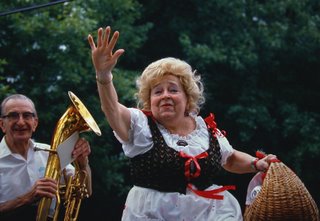
 Made the trek to Ohio yesterday for Obžínky. Despite missing the parade after leaving late, and getting rained on, I'm glad I went - though I wish I'd had more time there to catch up with my Uncle Frank (my mom's brother) and my other relatives on my mom's (Czech) side of the family.
 I did finally get to order a beer on my own at the lower bar in the hall (instead of stealing swigs from my uncle's) and of course I chose a Pilsner Urquell. Could it have been anything but?
 Though our outward man perish, yet the inward man is renewed day by day. -- 2 Corinthians 4:16
  Cuba, Ohio, Pennsylvania, Boston, Bellevue Borough, China, Italy and Bethel Park. Just a few compass points on this map that I'm unfurling. I wish I'd done a better job of appreciating some of the stops along the way, but there is no going back, and only hope for the future.
 The DTJ organization was formed by a group of tailors in Prague, 1897. The group was sympathetic towards the Social Democratic movement of that period. Gym work was started immediately, classes being held wherever room could be found, mostly at the Inns.
 For those of you who don't know what DTJ is, I'd like to take a moment to give you a brief explanation.


 Posts
Posts


